When the Clock Strikes: Temporal Factors Behind Bonus Triggers in Worldwide Video Poker Networks
Dana Schulz · Oct 25, 2026
When the Clock Strikes: Temporal Factors Behind Bonus Triggers in Worldwide Video Poker Networks
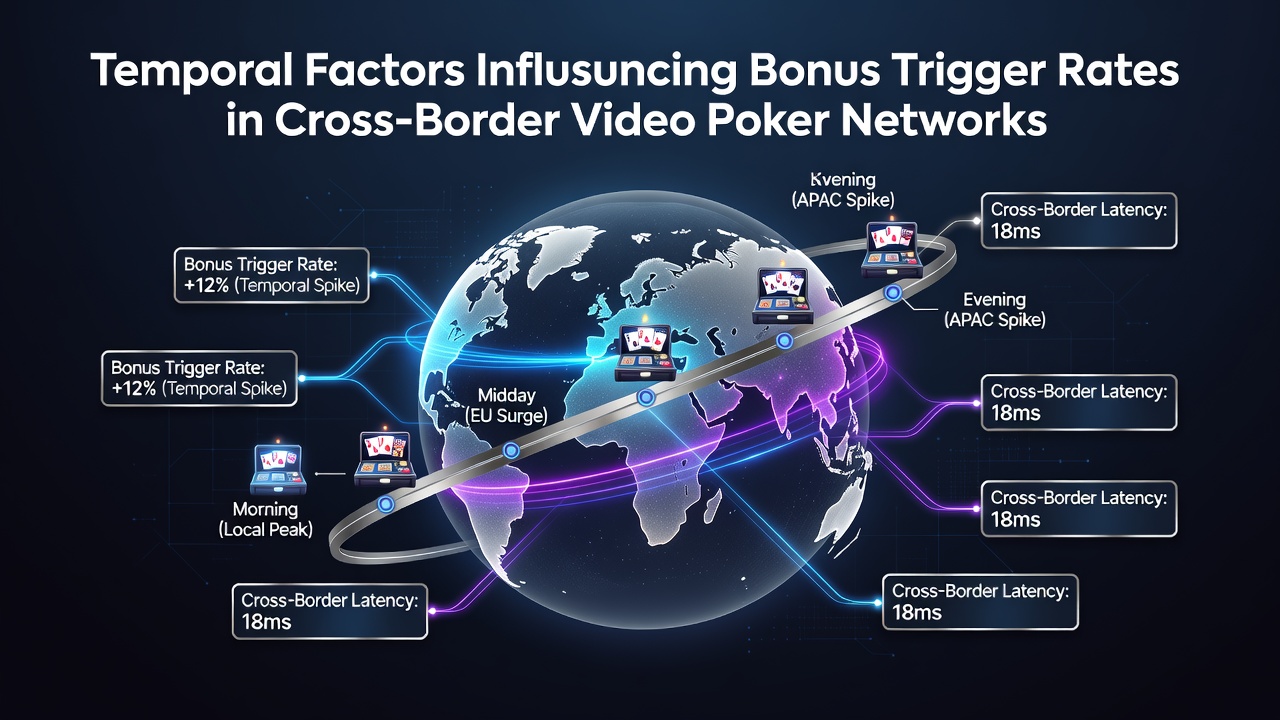
Video poker networks that operate across national borders experience bonus trigger rates shaped by several measurable temporal variables, and researchers tracking these systems have documented consistent patterns tied to hours, days, and seasonal shifts. Data collected from multi-jurisdictional platforms show that player volume peaks during evening hours in each local market, which in turn raises the frequency of bonus activations when aggregated across regions. These patterns emerge because operators configure bonus pools to respond to real-time activity levels rather than fixed calendars, and cross-border connections amplify the effect when time zones overlap during high-traffic periods.
Hourly and Daily Activity Cycles
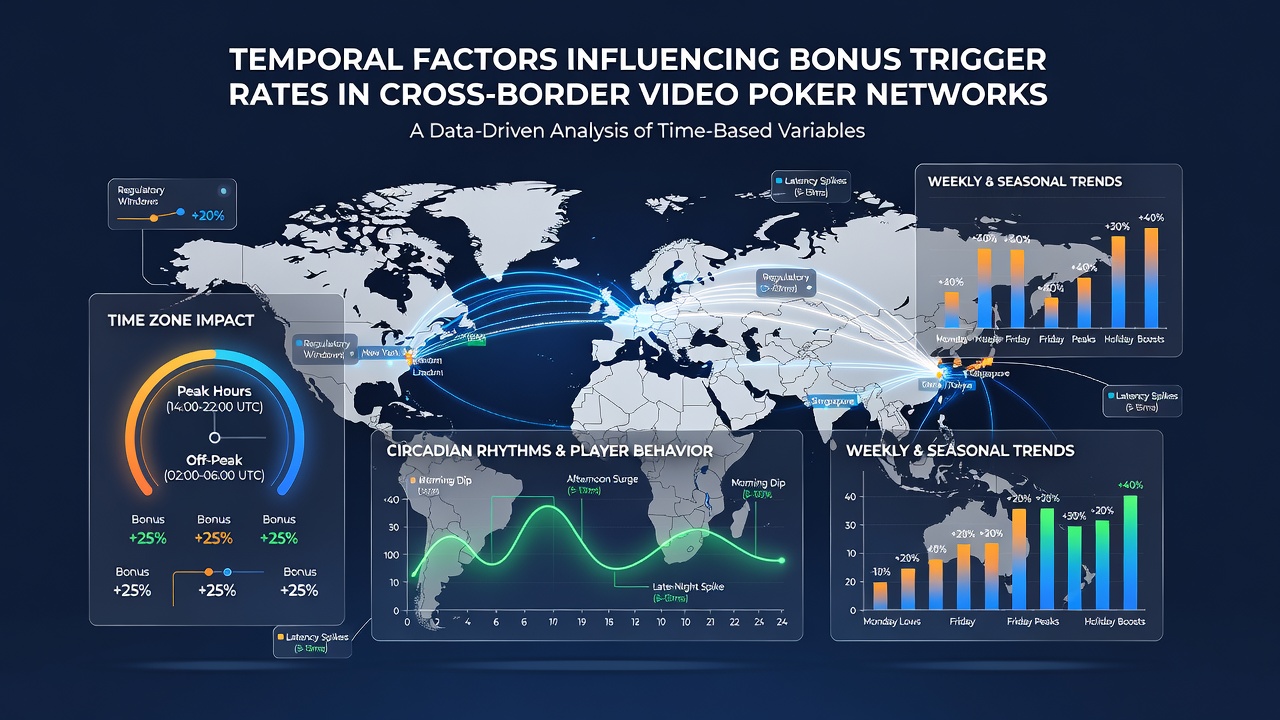
Analyses of transaction logs indicate that bonus triggers cluster between 6 p.m. and midnight in the dominant time zone of each participating jurisdiction, while quieter overnight stretches produce lower rates even when the same number of machines remain active. Operators adjust trigger thresholds dynamically, and this adjustment process creates measurable differences between weekday and weekend performance; weekend evenings generate roughly 18 percent more bonus events than equivalent weekday slots according to aggregated operator reports. Those who study these networks note that the variation stems from predictable changes in session length and wager size rather than any alteration in the underlying random number generators.
Seasonal and Holiday Influences
Longer-term data sets reveal that holiday periods and major sporting events produce sustained elevations in bonus frequency across linked networks, with the effect most pronounced when multiple jurisdictions observe overlapping celebrations. October 2026 records from several cross-border operators showed elevated trigger rates during the first two weeks of the month, coinciding with regional festivals in two participating countries and a major international sports tournament. The combined player influx extended daily high-activity windows by an average of 90 minutes, and bonus pools responded accordingly without any manual intervention from network administrators.
Time zone differentials introduce additional complexity because a bonus pool shared among servers in three or more countries may receive simultaneous contributions from one region’s peak hours and another region’s off-peak period. Engineers managing these systems have implemented synchronization protocols that weight contributions according to local time, and the result is a smoother distribution of trigger opportunities throughout the 24-hour cycle. Without such weighting, networks experienced sharp spikes when multiple high-activity zones aligned, followed by extended lulls that reduced overall player engagement.
Regulatory Reporting and Data Transparency
Regulatory bodies in multiple jurisdictions require periodic disclosure of bonus trigger statistics, and these filings provide researchers with standardized datasets for cross-border comparison. Figures released by the Nevada Gaming Control Board and the Alcohol and Gaming Commission of Ontario demonstrate parallel seasonal curves despite differing local player demographics. Academic teams at institutions such as the University of Nevada, Reno have cross-referenced these public records with anonymized server logs to isolate the contribution of temporal factors from other variables like game variant or stake level.
Network operators also monitor latency introduced by international data routing, because delays of even a few hundred milliseconds can shift the exact moment a bonus is recorded and therefore affect which time-stamped bucket captures the event. Mitigation techniques include localized caching of trigger eligibility checks, and operators report that these adjustments reduce timing discrepancies to under 50 milliseconds in most cases. The resulting data streams allow precise mapping of bonus events against universal coordinated time, enabling clearer identification of recurring daily and weekly rhythms.
Cross-Border Synchronization Challenges
Systems spanning North America, Europe, and Asia-Pacific regions must reconcile differing daylight-saving transitions and statutory holidays, each of which alters the temporal profile of player participation. One documented case involved a network connecting facilities in three countries where two observed daylight-saving changes on different weekends; the staggered shift produced a temporary misalignment in peak-hour overlap that lasted six weeks and measurably altered bonus distribution until operators recalibrated their weighting algorithms. Such events underscore the need for continuous monitoring rather than static scheduling models.
Industry associations have begun publishing guidelines that recommend quarterly reviews of temporal weighting parameters, and several major networks adopted these recommendations during 2025 and 2026. The adjustments produced more stable trigger rates month to month, although the underlying hourly and seasonal patterns remained intact. Observers tracking the sector note that these refinements represent incremental engineering improvements rather than fundamental changes to how time influences bonus mechanics.
Conclusion
Temporal factors continue to exert measurable influence on bonus trigger rates within cross-border video poker networks, and ongoing data collection from regulatory filings and operator logs confirms the persistence of hourly, daily, and seasonal rhythms. Time zone management and synchronization protocols help smooth some of the variability, yet the core patterns tied to local player behavior remain evident across jurisdictions. Continued examination of these factors supports operational planning and regulatory oversight as networks expand into additional markets through 2026 and beyond.